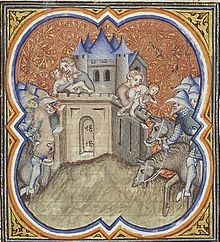
Today is Asara B’Tevet, the 10th of Tevet. It is the fast day that marks the beginning of the siege of Jerusalem by Nebuchadnezzar II of Babylonia—an event that began on that date and ultimately culminated in the destruction of the First Temple and the conquest of the Kingdom of Yehudah. In many ways this is the beginning of the long slog to our diaspora that only ended in 1948.

Nebuchadnezzar camps outside Jerusalem. Petrus Comestor‘s “Bible Historiale”, 1372
For the last 75 years this minor fast was relegated to the dustbin of history. What have we to commemorate when we have a country? Ever since the reunification of Jerusalem, why would we keep this fast day?
In our post October 7th reality in which Israel’s very existence in called into question, today’s fast seems very relevant. This sense of being under siege is acute in Israel with active fronts in Gaza, Syria, and Lebanon. And then we add in Yemen choking off the Red Sea and the long arm of Iran. We can count our blessings in Jordon and Egypt, but it seems that we are very much under siege. And today this sense of being under siege is way beyond Israel. The genocidal call for ” From the River to the Sea” can be heard throughout Europe and across North America. While are are used to White Nationalist’s calls that” Jews Will Not Replace Us” and we have endured shootings in the Tree of Life and Poway, there seems to be some thing new on college campuses. Reading the Greg Lukianoff and Jonathan Haidt‘s The Coddling of the American Mind it is hard not to see the irony of campuses that will cancel people under the Safetyism regime, do not see Jews as a minority worthy of protection or even consideration.

But what does this have to do with Asara B’Tevet?
While Israel is under siege, being a Jew in diaspora also feels that we are under a different variety of siege. While difficult, for those of us who have found solace in Jewish organizational life, this period of time has represented a revival and revitalization of sorts. My fear is not for the people who feel locked in with us, but rather for the many more Jews who feel that they are locked out. We might feel alone, but they are isolated. They are bowling alone and not benefiting from the warmth, support, and love of the Jewish community. There are many reasons that this is the case, but today I want to reflect on what we the insiders can do? When we are under siege the normative response would be to reinforce the walls. What can we do to protect ourselves during this time, without making Jewish life less accessible? I have ideas and I would love to hear your ideas.
 Said to Myself
Leave a comment