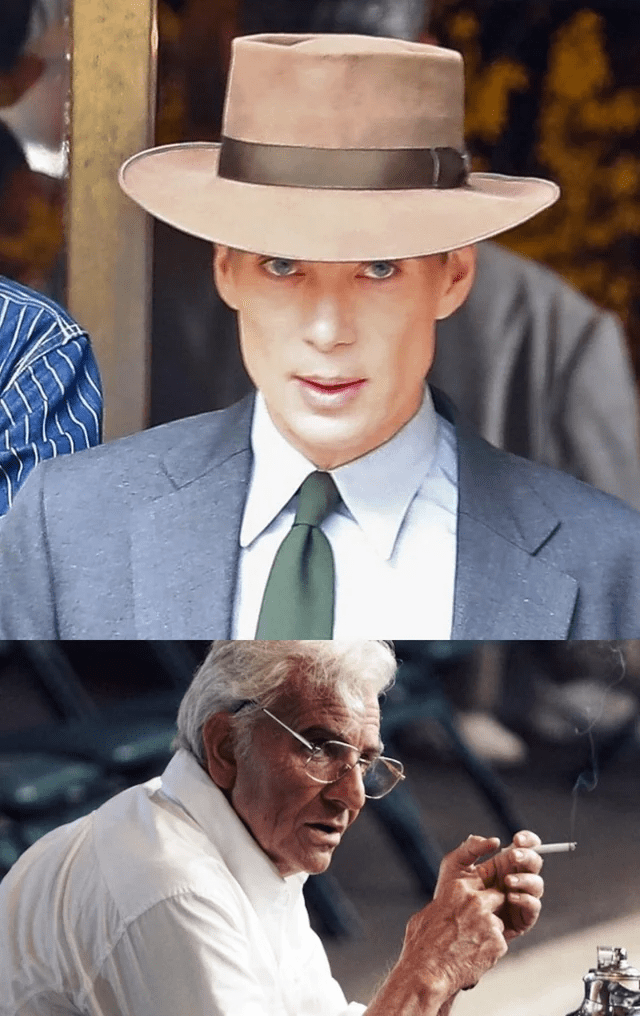
This last year we have seen our fair share of movies of great men. There seems to be a surfeit of bioepics in the theaters as of late. It just happens that two of the ones that hit the mark were Oppenheimer and Maestro, both bioepics about great Jewish men. Oppenheimer is the story of J. Robert Oppenheimer, the American theoretical physicist credited with being the “father of the atomic bomb” for his role in the Manhattan Project—the World War II undertaking that developed the first nuclear weapons. Maestro is a biographical romantic drama film that centers on the relationship between American composer Leonard Bernstein and his wife Felicia Montealegre. It is noteworthy that these movies depicting Jewish geniuses came out during the highest level of domestic anti-Semitism in years. Does the world love us or hate us?
A line from each of these two movies has stuck with me and connected to each other. In Oppenheimer we see a meeting between a young Oppenheimer and his mentor Niels Bohr. Oppenheimer admits that he is not good at mathematics to which Bohr says:
Algebra’s like sheet music, the important thing isn’t can you read music, it’s can you hear it. Can you hear the music, Robert?
Similarly, Bradley Cooper depicts an Leonard Bernstein at the end of his life reflecting on his own ability to make music. He says:
If summer doesn’t sing in you, then nothing sings in you. And if nothing sings in you, then you can’t make music.
In both movies in trying to depict the genius of these great Jewish men they explore their God given capacity to have the “music” within you.
I was thinking about this idea on B’Shalach, this week’s Torah portion. This week we read about the miracle of the Israelites salvation by the sea and their the reaction to this miracle with song. This is why we call this week Shabbat Shira, the Shabbat of song. It is easy to get lost in the miracle of what happened, but in the context of these two bioepics I would like to look at the person of Moche. In what way was the “music” within him?
Here we read:
But Moshe said to the people, “Have no fear! Stand by, and witness the deliverance which Lord will work for you today; for the Egyptians whom you see today you will never see again. The Lord will battle for you; you hold your peace!” Then Lord said to Moshe, “Why do you cry out to Me? Tell the Israelites to go forward. And you lift up your rod and hold out your arm over the sea and split it, so that the Israelites may march into the sea on dry ground.
Exodus 14:13-16
It seems to be all at once Moshe is encouraging the people, finds himself discouraged, and then encouraged by God. Despite his trepidation God tell him that the answer is in him. After all of the miracles that God did for them it is as if God is asking Moshe like the character of Niels Bohr if he can you hear the music.
Then the miracle happened and we see Moshe’s response. Here we read:
Then Moshe and the Israelites sang this song to Lord. They said:
Exodus 15:1
I will sing to Lord, for God has triumphed gloriously;
Horse and driver God has hurled into the sea.
Seeing this miracle helped them realize that summer sang within them.
Moshe, Oppenheimer, and Bernstein were each conflicted creative Jewish men. Each in their own way beheld the essence of creation. Each harnessed these this understanding to unleash their genitive powers of miracles, molecules, and music. In each we see the infinite potential of everyone. And at the same time we see in the juxtaposition of the stories of that this power comes with risks. Unlocking the power of creation could be used to be creative or destructive. We must all tap into our inner summer song, but we also have to be sure to use that power for good.
 Said to Myself
Leave a comment