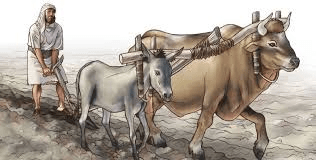
In Ki Tetzei, this week’s Torah portion, we have a plethora of commandments. It actually represents 12% of the commandments in the Torah in this week’s Torah portion. It is easy to lose track of all of the commandments as the come fast and furious. Mixed in the middle between Kilayim, the prohibition of mixing plant species, and shatnaz, the prohibtion of mixing linen and wool in your clothing, is the prohibition of having a mule and an ox work the ground together. There we read, “You shall not plow with an ox and an ass together.” (Deuteronomy 22:10) According to Rashi the same law applies to any two different kinds of animals. The same law applies also to merely driving them together (when not ploughing) while they are yoked together as a pair carrying any load (see Sifrei Devarim 232:1-2) What is the nature of this prohibition? And why is it sandwiched between these other two?
One answer is that it might be a question of purity of the different animals. Maybe we should not mix the pure along with the impure. Another answer is that we are being warned to look out for the weaker animal which will feel pushed to catch up to the stronger animal. This might be understood as the lens of equity. And yet another way to understand this prohibition is that we are looking out for the stronger animal. Will the stronger animal slack off? We should all be inspired to do our best. If we lower our standards and do not always strive, what are we?
The Torah is very concerned with mixing. But in looking at our crops or our clothing, we need not see a lesson in cruelty or an anthropopathic lesson in having a good work ethic. In life we should always be kind and be looking for good partners who will inspire us to be our best. In short, when it comes to this commandment, we should learn to never do anything half-assed.
 Said to Myself
Leave a comment