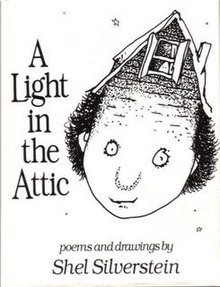
Last year Libi and I were walking home from shul one Friday night and we passed a large house on our way. She asked me if anyone lives there. Why? I asked. She reasoned that she had never seen a car there and therefore no one lives there. I looked up and pointed out that they light was on in the attic. Was this not proof that someone lived there?

Libi did not buy it. She thought that it was just proof that the previous owner mistakenly left the light on.
This image of the Light in the Attic reminded me of Shel Silverstein and an important Midrash about Lech Lecha, this week’s Torah portion. The Midrash is dealing with the question as to how did Avram ( O.G. Avraham) discover God and launch this venture called monotheism. There we read:
There once was a man on a journey who came across a bira doleket. He looked around, trying to find help to put out the blaze. He wondered, surely there must be someone who owns this palace, someone who cares for it. The man calls out: “is there anyone there? Is anyone responsible for this palace?” “Is it possible that this palace has no caretaker?!” At that moment, the owner of the palace peeks out and reveals himself. Avram said, “Is it possible that this world has no one to look after it? And then God peeks out and says: Lech Lecha, Go forth. (Bereshit Rabbah 29a)
The first question would naturally be, what is a bira doleket? So bira, meaning “palace” and doleket meaning “on fire.” This reading paints Avram as a heroic figure who sees a house fire and assumes that there must be someone inside to save. Even if Avram knows that he is putting himself in danger and he does not know that there is someone inside, the risk is worthy. In this frame monotheism is founded on a profound sense of empathy and altruism.
Rabbi Abraham Joshua Heschel, does not read doleket not as “on fire”, but rather, as “illuminated”. In this sense the house was aglow with flames and signs of life inside. In this translation this is an argument for the existence of God from design. The universe as a whole is like a machine; machines have intelligent designers; like effects have like causes; therefore, the universe as a whole has an intelligent designer, which is God. The argument was propounded by medieval Christian thinkers, especially Thomas Aquinas.
In either case it was how Avram observed the world that he acted or reasoned the existence of God. Thinking about this Midrash gives me a totally different read of the song that Billy Joel came out with this past year.
Joel sings:
I’m late, but I’m here right now
Is there still time for forgiveness?
Won’t you tell me how?
I can’t read your mind
But I see you now
As we’re layin’ in the darkness
Did I wait too long
To turn the lights back on?
On the surface this is a story of a husband, father, or sibling who is trying to renew a relationship that had grown fallow. Is it too later to renew this relationship? On another level this is the story of an artist who had not produced any new music in over 30 years coming out with a new song. Was it too late for Billy Joel to be productive as an artist. In the context of this Midrash one could read this song in a totally different level. In Heschel’s reading, might the singer be relating to a God who has been absent from our lives and wants to reconnect. Could God reilluminate the palace? Can God turn the light back on? Is it too late to reimagine that relationship?
In the other reading of the Midrash, we would need to ask if we have become callous and unconcerned with the world around us. Are we just “layin’ in the darkness”? Are we ready to run back into the world that is on fire in service of others? Can we reimagine our responsibility to join in making the world a better place, or is it too late?
I just hope that Libi buys it.
 Said to Myself
Leave a comment