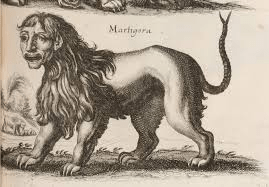
The manticore is a legendary creature from ancient Persian mythology, similar to the Egyptian sphinx that proliferated in Western European medieval art as well. It has the face of a human, the body of a lion, and the tail of a scorpion or a tail covered in venomous spines similar to porcupine quills. There are some accounts that the spines can be launched like arrows. It eats its victims whole, using its three rows of teeth, and leaves no bones behind.
Aelian (De Natura Animalium, 3rd century) serves as base text :
The manticore was allegedly a blue-eyed, human-faced wild beast of India. It was the size of the largest lion, with cinnabar-red fur. It has three rows of teeth, feet and claws like lions. It also had a scorpion-like tail with a (main) terminal sting that measured over 1 cubit, plus two rows of auxiliary stings, each a Greek foot long. The sting was instantly fatal. The stings could be fired sideways, forward, or backward, by orienting the tail accordingly, up to a 1 plethron distance range, and these stings regenerated afterwards. Only the elephant was immune to the poison. And it overcomes every beast except the lion.
The manticore hunts humans, lying in wait and even taking down even two or three men at a time. What a Wicked fantasy? Where does this awful imagination come from?
The perception of a human face on a manticore is a result of pareidolia. This is the tendency for us to perceive and impose a meaningful interpretation on a nebulous stimulus, usually visual, so that one detects an object, pattern, or meaning where there is none. Pareidolia is a specific but common type of apophenia (the tendency to perceive meaningful connections between unrelated things or ideas). Common examples include perceived images of animals, faces, or objects in inanimate objects. Other examples inlcude lunar pareidolia like the Man in the Moon or the Moon rabbit.

The concept of pareidolia may extend to include hidden messages in recorded music played in reverse or at higher- or lower-than-normal speeds.
I was thinking about this pareidolia when reading Balak, this week’s Torah portion. There we read the story of Bilaan’s donkey. The donkey understood the Angel’s presence while Bilaam, a prophet of God, completely missed the Angel. In the process it also revealed an ugly side of him by striking the donkey. The donkey is able to perceive the divine in ways that Bilaam is not initially able to perceive the divine in the Israelites.
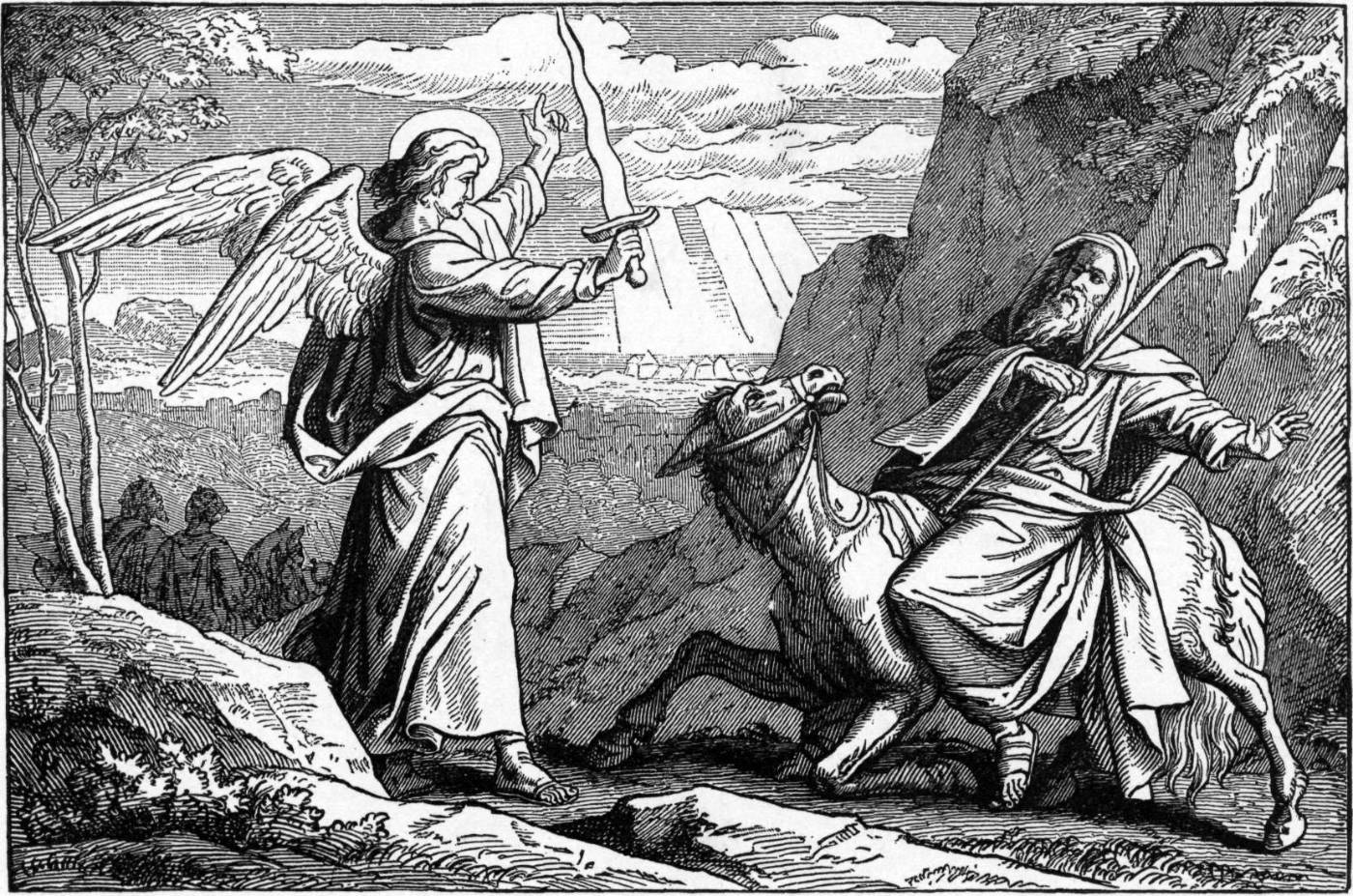
One could try to explain away the miracle of the talking donkey with pareidolia. But attributing human expressions to donkey is less interesting than Bilaam acting like an animal. In our lives we do not need to be angels and it might be too much to strive to see the diving in everything. That said, is it too much not be an ass?
 Said to Myself
Leave a comment