
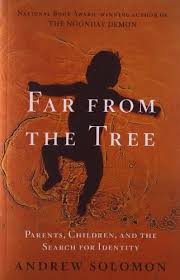
Andrew Solomon‘s Far from the Tree: Parents, Children, and the Search for Identity explores the relationship between parents and children who are fundamentally different from one another. Solomon introduces the central distinction between Vertical Identity and Horizontal Identity. As Solomon argues, Vertical Identity are traits passed down from parent to child, such as nationality, race, and language. This is often an unspoken inheritance that forms a basis of shared understanding and community. This stands in contrast to Horizontal Identity which are traits that emerge unexpectedly and are not shared with one’s parents. This can include a child being gay, having a disability, or being a prodigy. These identities are often acquired from a peer group and can create a significant chasm between parent and child. Solomon argues that this difference between these two types of identity is a defining and often challenging aspect of modern family life. The book details the profound struggles parents face as they come to terms with raising a child who is fundamentally different from them. Solomon shows how parents must navigate their grief over a child who doesn’t fit their expectations, but ultimately find a deeper, more meaningful love by embracing their child’s unique identity. He suggests that while we are often defined by our vertical identities, it is our horizontal identities that shape us in profound and sometimes painful ways.
Solomon concludes that while the experience of being “far from the tree” can be isolating, it also reveals a universal truth about the nature of love and acceptance. By learning to embrace difference, parents and children can build a new kind of community based on shared humanity rather than inherited traits.
Of the myriad of stories he told in this book there was one from his chapter on Down Syndrome that stuck with me. There was a couple Michelle and Jeff and their son Dylan who has Down Syndrome. Solomon points out that the mother could come to grips with Dylan’s difference because she had a 9 month lead on connecting during pregnancy on her husband. Michelle loved Dylan right away, but Jeff did not know what to do. As the case would be be Dylan needed many surgeries. Through the hardships of almost losing Dylan through these surgeries Jeff realized how much he loved Dylan. Solomon writes, “While it was too late for their marriage it was not to late for Jeff’s relationship with Dylan”.
I was thinking about this story from “Far from the Tree” in preparation for the Torah readings for Rosh HaShana. The readings focus on two pivotal narratives from Genesis: the birth of Isaac and Sarah’s fulfillment, which includes the banishment of Hagar and Ishmael (Genesis 21), read on the first day; and the Binding of Isaac (Akedah), the test of Abraham’s faith (Genesis 22), read on the second day. Both stories highlight themes of divine providence, answered prayers, and the enduring merit of ancestors. Like Jeff in the story, these readings ask us to reconsider Avraham’s relationships with his wives, Sarah and Hagar, and sons. Through the ordeals of sending Yishmael into the desert and taking Yitzhak to be sacrificed, we see the evolution of Avraham’s relationships with his’ sons. He grows closer to his sons, but might have been too late for this marriages.
In our prayers on Rosh HaShana we say, ” הַיּוֹם הֲרַת עוֹלָם – Today the world came into being”. Thinking about the story of Jeff and Michelle made we rethink what this means. For a mother, this coming into being is pregnancy. It is a long and intimate. For a father, as much as we might want to be part of the process, we are late to the party. Too often it is only in the context of that thing being risked that we snap in as protectors realizing our deep connection. From it inception, pun intended, mothers and fathers relate to this being differently. Solomon shows how parents must navigate their grief over a child who doesn’t fit their expectations, but ultimately find a deeper, more meaningful love by embracing their child’s unique identity. Mothers and fathers might do this “coming into being” thing differently.
May we all be blessed to realize the value of the important relationships in all of their Vertical and Horizontal identities.
Shana Tova U’Metuka
 Said to Myself
Leave a comment