As Brené Brown, my vulnerability Rebbe, teaches:
I spent a lot of years trying to outrun or outsmart vulnerability by making things certain and definite, black and white, good and bad. My inability to lean into the discomfort of vulnerability limited the fullness of those important experiences that are wrought with uncertainty: Love, belonging, trust, joy, and creativity to name a few.
We tend to enjoy black and white over grey, let alone the rest of the rainbow. But, this binary way of thinking does not help us access the rich color of life. My father used to say, ” Even death is good for the grave digger”. Like “love, belonging, trust, joy, and creativity” nothing good in life is truly all good or all bad. Which begs the question, why do we regress to binary thinking? How do we make sense of uncertainty in our lives?
It is interesting to look at this binary thinking in the context of Lech Lecha, this week’s Torah portion. Here Avram, Sarai, and Lot have left Egypt and are on their way back to the Promised Land with an abundance of cattle. There we read:
And there was quarreling between the herders of Avram’s cattle and those of Lot’s cattle.—The Canaanites and Perizzites were then dwelling in the land.— Avram said to Lot, “Let there be no strife between you and me, between my herders and yours, for we are kin. Is not the whole land before you? Let us separate: if you go north, I will go south; and if you go south, I will go north.” Lot looked about him and saw how well watered was the whole plain of the Jordan, all of it—this was before the Lord had destroyed Sodom and Gomorrah—all the way to Zoar, like the garden of the Lord, like the land of Egypt. So Lot chose for himself the whole plain of the Jordan, and Lot journeyed eastward. Thus they parted from each other; Abram remained in the land of Canaan, while Lot settled in the cities of the Plain, pitching his tents near Sodom. (Genesis 13:7-12)
Lot is given a binary choice by Avram. If he goes right, Avram will go left. And visa versa. We have read this book so many times that we know he will end up in Sodom and Avram will end up the Promised Land and miss the moment of choice. For Lot and Avram, at this moment everything seems up for grabs.
The whole journey that jump starts this week’s portion and the entire enterprise of the Jewish people is a pursuit of getting to the Promised Land. And yet still he is willing to give it up in the name of peace between the two groups of shepherds. It seems that Avram is willing to cut off his nose to spite his face. But before we get to the impact of the choice, how do we approach this moment of choice itself?
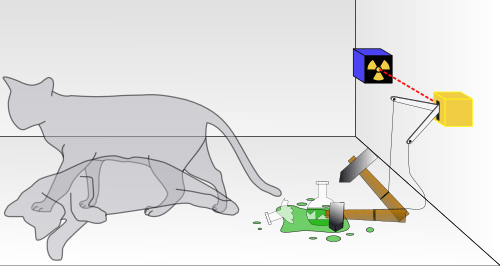
In an interesting way this moment of uncertainty is prescient for what would come to be known as Schrödinger’s cat. Schrödinger created this thought experiment in quantum mechanics to illustrate the paradox of quantum superposition applied to a macroscopic object. It describes a hypothetical cat in a sealed box with a device that has a 50% chance of killing it, based on a random subatomic event like radioactive decay. According to quantum theory, until the box is opened and the cat is observed, the cat exists in a superposition of being both alive and dead simultaneously.
In this moment of Lot’s choice the Promised Land is simultaneously Lot’s and Avram’s. And the same is true for Sodom.
Today we find ourselves in a moment of trying to keep peace between Israel and Hamas. It is hard to imagine Avram’s mindset to offer Lot this kind of choice. Peace seems to only exist in the grey space of vulnerability and mutual uncertainty. Just as with the cat, with this fragile peace Israelis and Palestinians are simultaneously alive and dead. Israel’s right coalition on one side and Hamas on the other side only see things in black and white. Neither can appreciate this paradox of peace. We need the moral clarity to say when something is right and and when something is wrong. We need to call out the immorality of Hamas and the Ben Gvirs. And at the same time we need to imagine another world. One filled with uncertainty. Black and white thinking will only get us so far. Our future of peace, love, belonging, trust, joy, and creativity needs us to hold uncertainty and imagine other possibilities.
 Said to Myself
Leave a comment