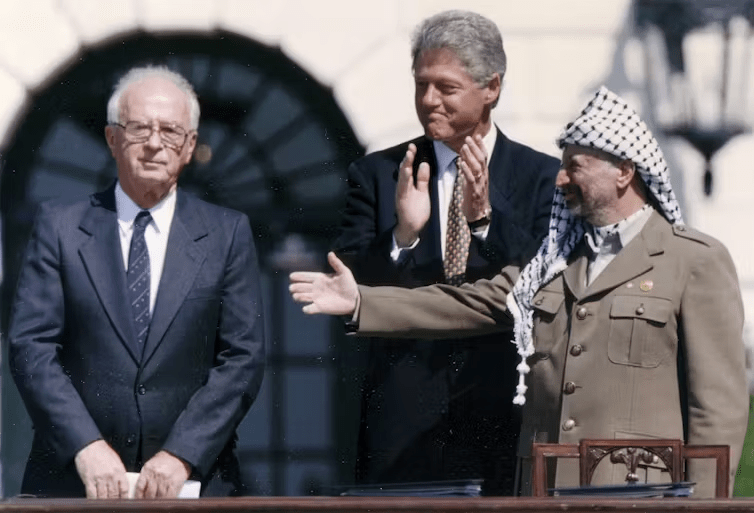

Today marks 30 years since Prime Minister Yitzhak Rabin was assassinated. On November 4th, 1995 at 21:30, he was senselessly shot dead at Kings of Israel Square in Tel Aviv at the end of a rally in support of the Oslo Accords. I pause to remember the man he was and his importance to the Jewish people. In President Bill Clinton’s eulogy for Rabin he wrote:
Yitzhak Rabin lived the history of Israel. Throughout every trial and triumph, the struggle for independence, the wars for survival, the pursuit of peace and all he served on the front lines, this son of David and of Solomon, took up arms to defend Israel’s freedom and lay down his life to secure Israel’s future.
As I look back on the years since his death I think about how much has changed and how much as stayed the same.

There are clearly growing gaps between the Greatest Generation (1901–1927), the Silent Generation (1928–1945), Baby Boomers (1946–1964), Generation X (1965–1980), Millennials (1981–1996), Generation Z (1997–2012), Generation Alpha (2013–2025), and what will be Generation Beta (2025–2039). We have not even begun to understand the impact of the recent political and environmental shifts let alone the effect of Covid-19 on this next generation. And on top of that we have been enduring the last two years since October 7th. The political divide in Israel and in the diaspora today seems intractable.
As much as Clinton was right that Rabin “lived the history of Israel”, at some fundamental level we need to ask ourselves which history of Israel we are trying to tell. Is it going to be a place for the politically right or of human rights? How will we hope to thread the needle of it being a local democracy and the home of the Jews? Will there be checks and balances or not? Will it be governed by the rule of secular law or the law of theocracy?
While I have my own political perspective, I am suspect everyone does. I do not ask these questions because I think it is simple, but because they are hard. These are existential questions that we need to struggle with over time. The Modern State of Israel is still a young project.
In seeking context to understand Rabin as the leader of Israel being murdered by his fellow Jew I keep coming back to Gedalia. According to Jeremiah and Second Book of Kings, Gedalia was appointed by Nebuchadnezzar II of Babylon as governor of Yehud province, which was formed after the defeat of the Kingdom of Judah and the destruction of Jerusalem, in a part of the territory that previously formed the kingdom. He was supported by a Chaldean guard stationed at Mizpah. On hearing of the appointment, the Jews that had taken refuge in surrounding countries returned to Judah.
Ishmael son of Nethaniah, and the ten men who were with him, murdered Gedalia, together with most of the Jews who had joined him and many Babylonians whom Nebuchadnezzar had left with Gedaliah (Jeremiah 41:2–3). The remaining Judeans feared the vengeance of Nebuchadnezzar and fled to Egypt. Some commentators have suggested that Ishmael slew Gedalia ‘because Nebuchadnezzar had appointed him governor’ (Jeremiah 41:2). He may also have found Gedaliah’s confident statement that ‘all will be well’ under Nebuchadnezzar (Jeremiah 40:9) tantamount to treason, especially given Babylon’s earlier treatment of the royal household (Jeremiah 39:6). Robert Carroll describes the assassination as ‘armed revolt against Babylonian authority and the execution of a collaborationist’. Is it possible that he was working with Babylonia AND had our best interests at heart?
This unchecked zealous sense of nationalism lead to a profound distrust and ultimately to the fratricide of Gedalia and Rabin. It has been 30 years since the assassination of Rabin, it has been over 2600 years since the assassination of Gedalia. We keep creating and recreating a politics of righteous indignation that is intolerable of people with whom we disagree. When will we learn?
 Said to Myself
Leave a comment