What do we own? Objects or property are all fleeting and useless in the end. Even if it is fleeting the only thing of value we really own is our time. It is in this time that we foster and cherish relationships. Just because we value time, it does not mean we know much about it. Our lives are a never-ending stream of “when” decisions. As we read in Kohelet:
A time for being born and a time for dying,
A time for planting and a time for uprooting the planted;A time for slaying and a time for healing,
A time for tearing down and a time for building up;A time for weeping and a time for laughing,
A time for wailing and a time for dancing;A time for throwing stones and a time for gathering stones,
A time for embracing and a time for shunning embraces;A time for seeking and a time for losing,
A time for keeping and a time for discarding;A time for ripping and a time for sewing,
A time for silence and a time for speaking;A time for loving and a time for hating;
A time for war and a time for peace. ( Kohelet 3: 2-8)
Yet we make these decisions of when to do something based on intuition and guesswork. Or worse, the allocation of our time is made for us by others, chance, or dumb luck.
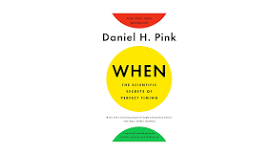
Timing, it’s often assumed, is an art. In When: The Scientific Secrets of Perfect Timing, Daniel H. Pink shows that timing is really a science.
Drawing on a rich trove of research from psychology, biology, and economics, Pink reveals how best to live, work, and succeed. How can we use the hidden patterns of the day to build the ideal schedule? In When, Pink distills cutting-edge research and data on timing and synthesizes them into a fascinating, readable narrative packed with irresistible stories and practical takeaways that give readers compelling insights into how we can live richer, more engaged lives.
There Pink writes:
I call time-outs like these “vigilance breaks”—brief pauses before high-stakes encounters to review instructions and guard against error. Vigilance breaks have gone a long way in preventing the University of Michigan Medical Center from transmogrifying into the Hospital of Doom during the afternoon trough. Tremper says that in the time since he implemented these breaks, the quality of care has risen, complications have declined, and both doctors and patients are more at ease. ( When)
He argues for the importance of vigilance breaks in the afternoon to refocus our time. This got me thinking about Mincha. Is this the vigilance break we need to help us refocus in the afternoon?
Regarding Mincha, Rabbi Yom Tov Lipman Heller, in his Tosefos Yom Tov explained the word “mincha” (from the Hebrew root word “menucha“) as meaning “rest”, the time when the sun is beginning to go down for a rest after its long day. This seems to align to Pink’s vigilance break. The Kedushat Levi sees much more in the name of the Afternoon Prayer in the context of the other daily prayers. In the Morning Prayer we express gratitude for God returning the refreshed soul back after the long night. Waking up is amazing and restorative. Even with all of our science; one feels a sense of relief that the night has passed and the sun is again shining its familiar warmth; therefore it is natural that upon waking, one would want to express this gratitude. Regarding the Evening Prayer, at night, when one is preparing to sleep during the long darkness, there is a feeling of trepidation. We say the Evening Prayer and rest easier with the comfort we will be taken care of and get through the night. However, as the Kedushat Levi argues, Mincha, the Afternoon Prayer, has no natural sense of obligation or gratitude associated with it. Mincha is a bonus and a special gift which we offer. For this reason the word “mincha” means “gift”. When one stops and takes a few minutes out in the midst of a busy day, to put aside all other concerns this speaks of a special relationship.
I was thinking about this topic this week in the context of Chaye Sara, this week’s Torah portion. The Talmud relates the idea that each service was established by one of the Patriarchs. Yitzhak established the Mincha, as it is written in ,
Yitzhak בָּ֣א מִבּ֔וֹא-had just come back from the vicinity of Beer-lahai-roi, for he was settled in the region of the Negev. And Yitzhak went out walking in the field toward evening and, looking up, he saw camels approaching.(Genesis 24:62-63)
The Gemara explains that “walking” here is a reference to prayer. (Berachot 26b). I am interested in this language of “בָּ֣א מִבּ֔וֹא”- “came from coming”. It is a weird turn of phrase. I can related that I often find myself stuck in an action. Sometimes I am in flow and sometimes I am stuck. This seems to be the context for Yitzhak’s Micha service. Micha is a rest and a gift to God. It is also a vigilance break. It is a much needed pause for ourselves to refocus our efforts to make sure we are in a groove and not a rut.
 Said to Myself
Leave a comment