In this week’s Torah portion, parshat Tetzaveh, we read about the sacred clothes made for Aaron and his sons who are going to be the priests. It says that these vestments provide them glory and splendor (Exodus 28:1). It is clear that there are many layers of meaning behind all of the layers of the clothing of the priest, but do the clothes make the man? Would the same people holy enough to serve as intermediaries for the Israelites be up to doing their job if it were not for the clothes?
It does seem true that clothing gives you a social context to understanding someone’s role in society. Therefore, while wearing certain clothes does not determine the color of our character, it might inspire us to act the part.
This week in reading about all of these vestments I was taken with the hem. There we read:
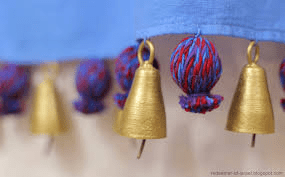
On its hem make pomegranates of blue, purple, and crimson yarns, all around the hem, with bells of gold between them all around: a golden bell and a pomegranate, a golden bell and a pomegranate, all around the hem of the robe. Aaron shall wear it while officiating, so that the sound of it is heard when he comes into the sanctuary before GOD and when he goes out—that he may not die. ( Exodus 28:33-35)
What is the story with this bells? Why is it important that it makes noise when he enter and exits? And why does his life depend on it? These questions evoke many thoughts. But the one I want to explore right now is the sound of him coming in and out of the Holy of Holies with the sound of these bells.
This sound is evocative of what Adam and Eve heard after they ate of the Tree of Knowledge. There we read:
They heard the sound of the ETERNAL God moving about in the garden at the breezy time of day; and the Human and his wife hid from the ETERNAL God among the trees of the garden. (Genesis 3: 8)
What did they hear? According to Rashi the plain meaning of the text is they they heard God walking in the Garden. In the Midrash another explain is given. This sounds represents God’s withdrawing from humanity due to their sin. There we read:
Rabbi Abba Bar Kahana said: It doesn’t use the word מהלך here, but rather מתהלך, which implies jumping and rising. The Shechina was originally in the lower worlds, but when Adam sinned, the Shechina went [up] to the first heaven (Bereshit Rabbah 19:7)
These represent very different sounds. What is the vector of the sound? Is God close at hand? Is God coming close to punish? Is God leaving them itself the punishment?
In interesting ways all of these sounds can be heard in the hem of the High Priest. He is entering on Yom Kippur for the sake of expiating us from our sins. In a simple way this sound represents his presence in entering or exiting the Holy of Holies. As our emissary it is as if he is reentering the Garden of Eden unburdened by sin to be in the presence of God. In another dimension, other people from the outside of the Holy of Holies would not see the High Priest but they could hear the sound of the hem. In a deeper way this sound represents God’s presence or withdrawal. Will we be accepted or rejected is an open question. And on the deepest level, maybe this is a false dichotomy between the sound of God and the sound of the High Priest. Today God will only be known through the acts of humanity. In hearing these bells we are reminded of our being created in God’s image. The High Priest’s movements create a sound which is experienced as God’s moving. As Mahatma Gandhi famously said, “Be the change that you wish to see in the world.”
But we are still left with the question of the vector of this sound. As I often quote, Rav Menachem Mendel Schneerson famously said, “If you see what needs to be repaired and know how to repair it, then you have found a piece of the world that God has left for you to perfect. But if you only see what is wrong and what is ugly, then it is you yourself that needs repair.” This sound of the hem is that invitation. If we believe the sound is the presence or God’s moving close, embrace it. If we believe it is moving away it, it is out job to fill that void. The sound of the hem in that invitation to partner with God. How do we rock these bells?
 Said to Myself
Leave a comment