With the advent of this war between Iran, Israel, America, and now Iran’s neighbors we are thick of it. Multiple times people have remarked that we are in the fog of war. The term seeks to capture the uncertainty regarding one’s own capability, adversary capability, and adversary intent during an engagement, operation, or campaign. Military forces try to reduce the fog of war through military intelligence and friendly force tracking systems.
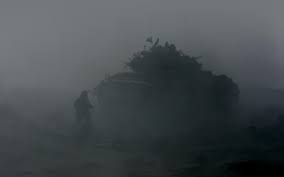
The first known use of the exact phrase in text dates to 1836 in a poem entitled “The Battle of Bunker Hill” by McDonald Clarke. The poem describes an assault by British forces upon an American redoubt during the 1775 Battle of Bunker Hill:
Will they dare a third attack?
Is a question seen in every eye;
Old Put across the neck and back,
Rides slowly, their vengeance to defy—
Wildy, in that deadly hour,
The Ramparts shove their bolted shower,
While mid the waving fog of war,
Thunders the Yankee’s loud hurrah”
The term has become commonly used to define uncertainty mechanics in wargames. It can only be used to explain away immoral things that happen unintentionally in the course of the horrors of war.
I was thinking about this when reading the end of this Vayakel Pekudah, this week’s Torah portion, at the end reading the Book of Exodus. The Tabernacle is completed and all its components are brought to Moshe, who erects it and anoints it with the holy anointing oil, and initiates Aaron and his four sons into the priesthood. A cloud appears over the Tabernacle, signifying the Divine Presence that has come to dwell within it. The we read:
And he set up the enclosure around the Tabernacle and the altar, and put up the screen for the gate of the enclosure. When Moshe had finished the work, the cloud covered the Tent of Meeting, and the Presence of GOD filled the Tabernacle. Moshe could not enter the Tent of Meeting, because the cloud had settled upon it and the Presence of GOD filled the Tabernacle. When the cloud lifted from the Tabernacle, the Israelites would set out, on their various journeys; but if the cloud did not lift, they would not set out until such time as it did lift. For over the Tabernacle a cloud of GOD rested by day, while fire would appear in that cloud by night—in the view of all the house of Israel throughout their journeys. (Exodus 40:33-38)
From here we see that God did not “enter” it until it was done, but once God was there, Moshe could not enter it. God’s presence is a cloud that determines if this Tribe traveling in the desert can move or not.
Where the Fog War is an image of uncertainty, God’s Cloud in the Tabernacle is definitive. It is easy enough to explain this as the difference between mortal and divine affairs, but all too often people evoke God in their wars. I have never seen anything too holy about Holy Wars. That said a Gemara does play with this image and an element of this uncertainty. There we read:
Rabbi Zerika raised a contradiction between verses before Rabbi Elazar, and some say that Rabbi Zerika said that Rabbi Elazar raised a contradiction: It is written in one place: “And Moshe was not able to enter into the Tent of Meeting because the cloud dwelt on it” (Exodus 40:35), as Moshe was unable to enter the cloud. And it is written elsewhere: “And Moshe came into the cloud” (Exodus 24:18). This teaches that the Holy One, Blessed be God, grabbed Moshe and brought him into the cloud since he could not enter on his own. (Yoma 4b)
It seems that there was a grey zone in which Moshe was pulled in.
Similarly, no one should want war. There is nothing good about war. We should only enter them if we are “grabbed” into them. That said, once there we can never relent on our mandate for moral clarity or contribute to obfuscating the situation.
This week alone there were 4 attacks on synagogues worldwide. Iran has been calling for the end of Israel and death of Jews since 1979. They have spent their nations wealth supporting proxies to flight Israel and kill Jews all over the globe. As Jews we are so used to the history and persistence of Antisemitism that we ourselves have normalized violence against Jews. 70% of Iran want a new government and liberation for the IRGC. Where is the moral clarity?
Israel is not perfect and we should all call them out on missteps, but this is not what is going on. Natan Sharansky, a former Soviet refusenik, Israeli politician, and prominent campaigner against antisemitism, is best known for developing the “3D Test” to distinguish legitimate criticism of Israel from antisemitism. He argues that anti-Israel sentiment crosses the line into antisemitism when it utilizes:
- Demonization (portraying Israel as inherently evil).
- Double Standards (singling out Israel for treatment not applied to other democratic nations).
- Delegitimization (denying Israel’s right to exist).
In these terms pretending you can be an Anti-Zionist and not be Antisemitic today is just a lie.
That said, we still have so much up in the air right now regarding the future of Israel, the Middle East, and Jews worldwide. Will we stay put or move forward? Are we in a groove or stuck in a rut? Did we just get grabbed up into the Cloud of God. Will be or cause casualties amidst the Fog of War? The future is uncertain.
 Said to Myself
Leave a comment