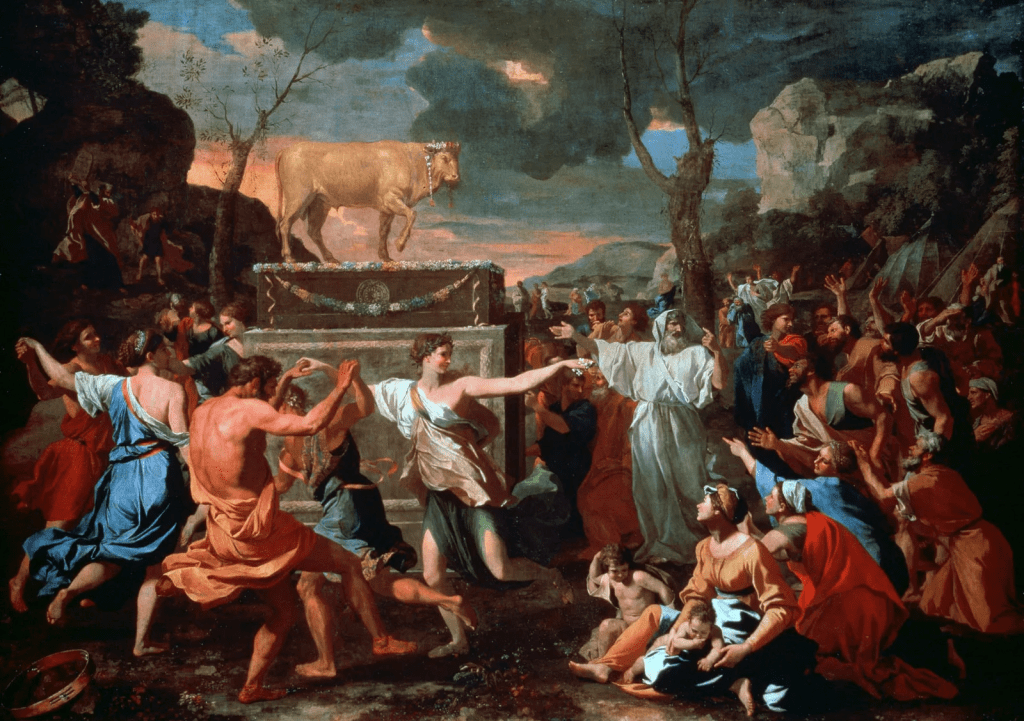
The main event in Ki Tisa, this week’s Torah portion, is the GCI, the Golden Calf Incident. Only recently getting the Torah it was pretty clear that idolatry was a big No No. It seems so confusing. The people had just experienced so many miracles in their lives, why would they forsake the God that delivered them out of Egypt for a molten god of their own design?

We see in the text in the Torah portion:
When the people saw that Moshe was delayed [boshesh] in coming down from the mountain, the people gathered against Aaron and said to him, “Come, make us a god who shall go before us, for that fellow Moshe—the man who brought us from the land of Egypt—we do not know what has happened to him.”
Exodus 32:1
The simple answer to the origin of the GCI is that they experiences Moshe being late. in this context we see that this is less of a faltering in their faith in God and anxiety around Moshe’s returning. Imagine Moshe’s surprise. He did not experience time in the same way. He did not know that he was late.
On this we learn an interesting Gemara:
And Rabbi Yehoshua ben Levi said: What is the meaning of that which is written: “And the people saw that Moshe delayed [boshesh] to come down from the mount” (Exodus 32:1)? Do not read the word in the verse as boshesh; rather, read it as ba’u shesh, six hours have arrived. When Moshe ascended on High, he told the Jewish people: In forty days, at the beginning of six hours, I will come. After forty days, Satan came and brought confusion to the world–[v’irbuv at haOlam] , and it was impossible to ascertain the time. Satan said to the Jews: Where is your teacher Moshe? They said to him: He ascended on High. He said to them: Six hours have arrived and he has not yet come. Surely he won’t. And they paid him no attention. Satan said to them: Moshe died. And they paid him no attention. Ultimately, he showed them an image of his death-bed and an image of Moshe’s corpse in a cloud. And that is what the Jewish people said to Aaron: “For this Moshe, the man who brought us up out of the land of Egypt, we know not what has become of him” (Exodus 32:1).
Shabbat 89a
In the imagination of Rabbi Yehoshua Ben Levi the people did not lose faith in God or even Moshe, but rather the had a distorted experience of time. On Satan in this story Rashi explains:
Satan came: He is the evil inclination that makes a person sin, he is the one that ascends and accuses. [And the one who says] that he is the trait of strict justice is not correct in my eyes.
Rashi on Shabbat 89a
Their downfall, and in many ways our downfall, is our twisted inclinations around experience of time. Like the Israelites in the wilderness, we too are living in an era of V’irbuv at haOlam- our inclinations have completely befuddled our temporal sense of reality.
Most of us can related to this twisting of time over the last four years. I have no memory of the sequence of things during Covid. In many ways it was just a blip of time. That being said, the experience of time since October 7th is like Covid and yet still different.
Last week I was in Israel. It is very clear to me that they are living in a totally different time zone. For many people in Israel, they are still in October 7th even over 147 days later. That is a lot more that just the 7 hour difference from Eastern Standard Time.
In many ways Israeli society is in Aninut. They are unable to move on to the next mitzvah or any other consideration because they are stuck with the mitzvot at hand. The recovery the hostages paramount. This stasis is accented by news of more missiles, death of solders, or death in Gaza. While I am worried about Israelis and Palestinians, I am also worried about the Jewish people. What is the consequence of North American Jewry moving on with our experience of time? Are we being confused by Satan, lost in V’irbuv at haOlam. Just as Moshe’s return was complicated as they had divergent experiences of time, how will Israel and the Diaspora reconnect when “this is over”?

 Said to Myself
Leave a reply to Arthur Schwartz Cancel reply