When I was young I asked my father, “Where were you when you heard that JFK was shot?” At the time I was shocked by the speed, clarity, and precision of his response. He described with vivid details as to where he was when he heard the news. It was only years later when my son Yadid asked me where I was when 9/11 happened, that I understood my father’s response to the assassination of JFK. I responded with a similar clarity. In retrospect, I suspect my father and I are just like everyone else. These seismic incidents alter the landscape of our memory. These cataclysmic events push up mountain peaks, forever perched above the clouds of our quotidian existence.

I was thinking about this recently, preparing for Bein ha-Metzarim– this period of time “Between the Straits”. This is the three week period of mourning commemorating the process leading to the destruction of the first and second Jewish Temples. The Three Weeks start on the 17th of Tammuz and end on the Tisha B’Av. It makes sense that the 9th of Av would be seen as the nadir of the Jewish calendar. In many ways the end of the process overshadows the rest of the time. I would contend that this year should be different. I think we need to explore the 17th of Tammuz through a new lens after the events of October 7th.
According to the Mishnah in Taanit, five calamities befell the Jewish people on this day:
- Moshe broke the two tablets of stone on Mount Sinai, when he saw the Golden Calf
- During the Babylonian siege of Jerusalem the daily tamid offering ceased to be brought because no sheep were available
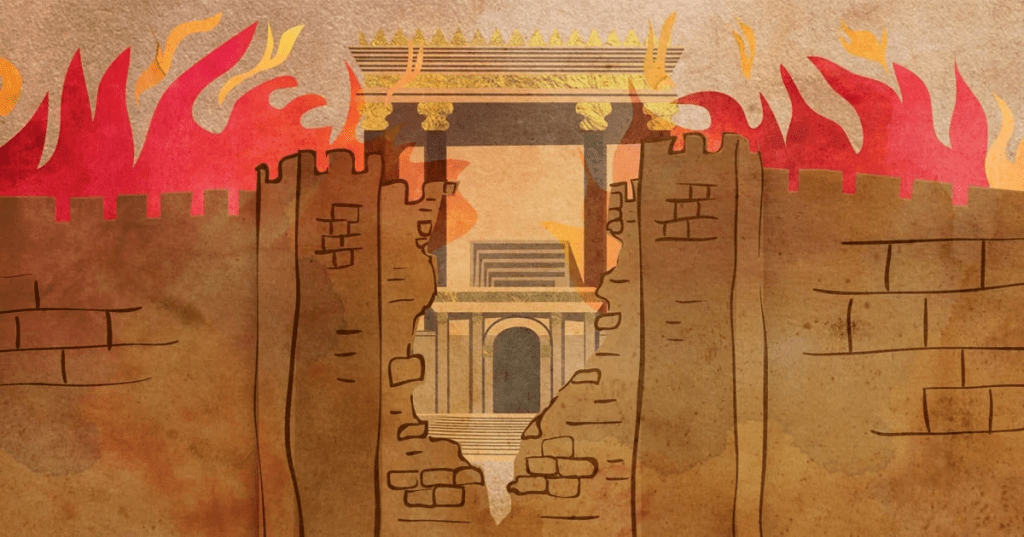
- During the Roman siege of Jerusalem, the city walls were breached, leading to the destruction of the Second Temple on Tisha B’Av
- Prior to Bar Kokhba’s revolt, Roman military leader Apostomus burned a Torah scroll
- An idol was erected in the Temple. (Taanit 4:6)
While these are all difficult moments for our people, the breach of the walls of Jerusalem takes on particular importance today. The Jerusalem Talmud maintains that this is not just the date that the Romans breached the wall after a lengthy siege, but this is also the date when the Babylonians breached the walls of Jerusalem on their way to destroying the first Temple. What did it feel like for the people in Jerusalem when the Roman’s or Babylonians breached the walls of the city? I simply do not know.

I can relate to the destruction of our Temples. Zion and Israel have been the focus of our yearning for 2000 years. But what do we make of the 17th of Tammuz? Our disconnection to their feelings have made it hard to make sense on this fast day outside of the beginning of this 3 week process. But, this year I think that has changed.
In the last 9 months I have asked countless Israelis and Jews worldwide, “Where were you when you heard about the breaching of the fence with Gaza?” Like my father each and everyone responds with a haunting lucidity as to where they were, what they were doing, and how it still impacts them today. For each one it seems that this was a moment that the world stopped moving. We have reentered Jewish memory and now we can empathize with the people of Jerusalem thousands of years ago when they heard the news that their walls were breached.
If we understand the historical significance of October 7th in the context of the 17th of Tammuz, we understand that this past year has put our people Bein ha-Metzarim. We are again between the straits. The difference is that this time we have no idea how it will end. Does the breaching of the fence imply an inevitability of yet another destruction or will we plot a new path out of these straits?
 “The Siege and Destruction of Jerusalem by the Romans Under the Command of Titus, A.D. 70” by David Roberts |  The Failure of the Fence October 7th |
To offer an answer to this I invite us to look at the first event that we attribute to this inauspicious date. It was on the 17th of Tammuz that Moshe came down from Sinai with the original tablets only to see the people involved in the idolatrous incident of the Golden Calf. Moshe breaks the first set of tablets and then admonishes them for being rebellious against God. Moshe shifts the conversation and speaks of God’s forgiveness of their sins, and the Second Tablets following their repentance. According to the opinion of Rabbi Meir both the broken tablets and these new tablets are placed in the Ark in the Holy of Holies in the Temple ( Baba Batra 14b). Why are both places there? What is so holy about broken tablets?
Clearly after the Sin of the Golden Calf the only way forward was for us to plot a new path with a new set of Tablets. But if we forget about our failures we would be condemned to repeat them. In this way both the broken tablets that represented our shortcoming and the new tablets representing our new commitments are sacred and were placed in the ark in the Holy of Holies.
The 17th of Tammuz and October 7th both represent tectonic shifts of Jewish life. Where the story of the 17th of Tammuz ends with the destruction of Tisha B’Av, today after October 7th need not end with the same fate. Our story is not written yet. We need to be asking ourselves, “Where were we when you heard about the events of October 7th?” We need to lift sift through the rumble and learn the lessons from our errors. While necessary, it will not be enough for us just to gather the sacred fragments of our memory. We also need to ask ourselves, where were we on October 6th? What is our responsibility having allowed this situation to come about? And where are we today? What are the new Tablets that we will commit ourselves. Rabbi Abraham Joshua Heschel wrote: “Morally speaking, there is no limit to the concern one must feel for the suffering of human beings. Indifference to evil is worse than evil itself, [and] in a free society, some are guilty, but all are responsible.” It is only with the broken and new tablets that we will have a way to move forward that will not end in destruction.

 Said to Myself
Leave a reply to Kinah for Be’eri – Said to Myself Cancel reply