The second part of Behar-Bechukotai, this week’s Torah portion, details the blessings for obeying God’s laws (prosperity, peace) and the curses for abandoning them (exile, famine). There we read:
As for those of you who survive, I will cast a faintness into their hearts in the land of their enemies. The sound of a עָלֶ֣ה נִדָּ֔ף- driven leaf shall put them to flight. Fleeing as though from the sword, they shall fall though none pursues. (Leviticus 26:36)
As Joseph Heller wrote in his novel Catch-22, “Just because you’re paranoid doesn’t mean they aren’t after you.” While there will be many punishments, this one seems like a phycological disposition of timidity and faint-heartedness. But what is the rustling of leaves? A leaf which the wind pushes along and beats it against another leaf, so that, in tapping it, it produces a sound. A leaf is harmless and two leaves making a sound against each other is equally harmless, but still this noise strikes fear in the hear of the people when they are being disobedient.
We see this lanuage again in the book of Job. There we read:
Why do You hide Your face, And treat me like an enemy? Will You harass a הֶעָלֶ֣ה נִדָּ֣ף – driven leaf, Will You pursue dried-up straw? (Job 13:24-25)
This seems to be in response to our Torah portion. Will anyone have to suffer so much? What kind of God would be vindictive enough to make that leaf shudder?
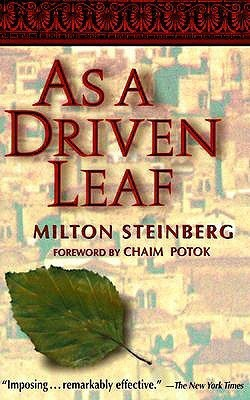
It is from here that we get the title for Rabbi Milton Steinberg’s As a Driven Leaf (1939). It is a historical novel set in Roman Palestine during the second century C.E. It tells the tragic, fictionalized story of Elisha ben Abuyah, a real, historical Talmudic sage who was a brilliant scholar, esteemed rabbi, and member of the Sanhedrin (the highest Jewish court). From a young age, Elisha is torn between faith and reason. On one side he had the world of his ancestors, centered on the Law (Torah), tradition, community, and the revealed truths of God. And on the other he had the seductive, logical world of philosophy, science, and the rational search for truth, which had flourished under Roman influence. In the end he was declared a heretic and excommunicated by his Jewish community. He dies a broken, disgraced, and miserable man, having lost his faith, his community, and the very truth he sought.
Elisha becomes the “driven leaf”—a brilliant man tossed helplessly by the winds of intellectual doubt and external historical forces, lacking the internal roots of a cohesive belief system to anchor him. The book argues that pure rationalism, divorced from compassion and community, ultimately leaves one morally and spiritually empty.
This reminds me of the movie the Wall by Pink Floyd. The main character Pink endures a series of traumas—the death of his father in WWII, an overprotective mother, and an abusive school system. He views each of these painful events as a “brick” used to build a mental wall between himself and the world. Once the wall is complete, Pink spirals into a drug-fueled detachment. This culminates in a hallucination where he imagines himself as a fascist dictator, turning his inner pain into outward hate. Eventually, Pink’s conscience puts him on a mental trial. He is forced to confront his past and expose himself to reality and human connection once more.
In the context of the judge ordering Pink to “tear down the wall,” we see anew the curse from our Torah portion. The curse is not just to have paranoia at the sound of the leave, but that if we disobey we will be like the leaf rustling about the world disconnected from the tree. The only answer is being open, vulnerable, and striving to connect to the community and Torah. How sad is that leaf disconnected from the Tree of Life?


Leave a Reply