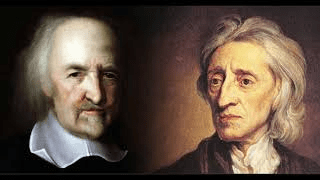
One of the more interesting disagreements in philosophy is between Thomas Hobbes and John Locke regarding concept of the “state of nature.” They both explore a hypothetical world before societies, laws, or governments existed. Each one was trying to explain why humans form political structures. However, they had fundamentally opposed views on what that natural state looked like and why we need to escape it.
Outlined in his Leviathan (1651), Hobbes held a pessimistic view of human nature, believing that people are inherently selfish, competitive, and driven by a desire for power. Because resources are scarce and humans are roughly equal in their ability to harm one another, Hobbes argued the state of nature is a constant, violent “war of every man against every man.” He famously described life in this condition as “solitary, poor, nasty, brutish, and short.” For Hobbes, to escape this perpetual fear and violence, humans agree to a social contract. They surrender their natural freedoms to an absolute, undivided sovereign the “Leviathan” whose immense power guarantees order, security, and peace.
Outlined in his Second Treatise of Government (1689, Locke believed that humans are inherently rational and moral creatures guided by “natural law,” which dictates that no one should harm another in their life, health, liberty, or possessions. Locke’s state of nature is not a war zone, but a condition of perfect freedom and equality where individuals possess natural rights to life, liberty, and property. However, it is unstable. Because there is no impartial judge or executive power, individuals must act as their own police and judges, making property insecure and justice subjective. For Locke, humans form a government not out of pure terror, but as a practical measure to protect their natural rights and settle disputes fairly. Government exists only by the consent of the governed, and if a ruler becomes a tyrant, the people have the moral right to rebel and replace them.
I was thinking about this disagreements when reading the first words of Ki Teitze, this week’s Torah portion. There we read:
Ki Teitze– When you go out to war against your enemies, and the ETERNAL your God delivers them into your power and you take some of them captive ( Deuteronomy 21:10)
What does “go out” mean here? A simple reading is when your soldiers take the field of battle. Many interpreters understand it to mean when they leave the land and fight a war outside the land of Israel. That is the “going out”. In the spirit of this “State of Nature” debate, might we read it as when you go out of your state of your natural way of being? YOu could disagree but I think that this reading would clearly put us in the Locke camp. Our natural state of being at peace and pursuing peace and liberty for all.
This opinion seems to be supported by the Isaiah. There he famously prophesizes :
God will judge between the nations
and will settle disputes for many peoples.
They will beat their swords into plowshares
and their spears into pruning hooks.
Nation will not take up sword against nation,
nor will they teach war anymore. ( Isaiah 2:4)
This is a wonderful aspiration for peace. Similar to Locke, here we see that war is not in our nature, rather warcraft is something that needs to be taught. But still for this to work out it seems that God needs to step into be the Leviathan. While I believe that the Bible aligns with Locke, his debate with Hobbes is far from over. What is our natural state of being?


Leave a Reply