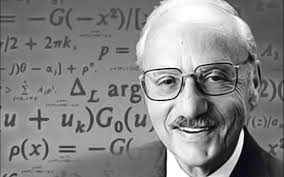
In 1939, near the beginning of his class Professor Spława-Neyman wrote two math problems on the blackboard. George Dantzig, one of his students, arrived late and assumed that they were a homework assignment. According to Dantzig, they “seemed to be a little harder than usual”, but a few days later he handed in completed solutions for both problems, still believing that they were an assignment that was overdue. Six weeks later, an excited Spława-Neyman eagerly told Dantzig that the problems he had solved were two of the most famous unsolved problems in statistics. He had prepared one of Dantzig’s solutions for publication in a mathematical journal. How did Dantzig’s not knowing that the “homework” was impossible open up a new possibility of doing something hard?
I was thinking about this story when reading Shlach, this week’s Torah portion. Here we learn that Moshe sends twelve spies to the land of Canaan. Forty days later they return, carrying a huge cluster of grapes, a pomegranate and a fig, to report on a lush and bountiful land. But ten of the spies warn that the inhabitants of the land are giants and warriors “more powerful than we”; only Caleb and Joshua insist that the land can be conquered, as God has commanded. What made the ten spies think that this task was impossible while Caleb and Joshua believed that it was possible? What is the similarity between Caleb, Joshua, and Dantzig?
This question reminds me of one of my favorite books, The Art of Possibility: Transforming Professional and Personal Life. This book combines Benjamin Zander’s experience as conductor of the Boston Philharmonic and his talent as a teacher and communicator with psychotherapist Rosamund Stone Zander’s genius for designing innovative paradigms for personal and professional fulfillment. The authors’ harmoniously interwoven perspectives provide a deep sense of the powerful role that the notion of possibility can play in every aspect of life. Through uplifting stories, parables, and personal anecdotes, the Zanders invite us to become passionate communicators, leaders, and performers whose lives radiate possibility into the world. There they write:
Every problem, every dilemma, every dead end we find ourselves facing in life, only appears unsolvable inside a particular frame or point of view. Enlarge the box, or create another frame around the data, and problems vanish, while new opportunities appear. (The Art of Possibility)
What would it take to see ever challenge like Dantzig as homework that is just “a little harder than usual”? Caleb, Joshua, and Dantzig model living in the possible.


Leave a Reply