I am getting excited to see Christopher Nolan‘s Odyssey. In preparation for seeing this new movie I took a moment to review the original. Attributed to Homer, the Odyssey is an ancient Greek epic poem that picks up immediately after the Trojan War. While the Iliad is about war and pride, the Odyssey is fundamentally a story about endurance, identity, and coming home. It tells the ten-year journey of Odysseus, king of Ithaca, as he tries to return home after fighting in Troy for ten years, while his wife Penelope and son Telemachus defend their kingdom against a host of opportunistic suitors.
The epic isn’t told in strict chronological order or even as any linear narrative —it opens nearly ten years after the war has ended. Back in Ithaca, everyone assumes Odysseus is dead. Over 100 arrogant suitors have invaded his palace, devouring his livestock and badgering his loyal wife, Penelope, to marry one of them.
Odysseus has been held captive for seven years by the nymph Calypso on her island, Ogygia. Zeus orders her to release him, and Odysseus builds a raft to escape. After shipwrecking on the island of the Phaeacians, Odysseus tells the King his famous back-story. Odysseus’s first story is how he blinds the giant Polyphemus a Cyclops to escape his cave. Before leaving, Odysseus arrogantly shouts his real name. Polyphemus, a son of Poseidon, curses Odysseus, inciting the sea god’s wrath. The next story about Circe, a sorceress, who turns Odysseus’s crew into pigs. After becoming her lover for a year, she instructs him to visit the Underworld. There Odysseus speaks to the prophet Tiresias, his fallen comrades, and his mother’s ghost, learning what it will take to reach home. He then tells of how he survives the alluring songs of the Sirens, Scylla, a six-headed sea monster , and Charybdis, a ship-devouring whirlpool. And finally he shares how his star-crossed men kill the sacred cattle of Helios despite warnings. Zeus strikes their ship with a bolt, killing everyone except Odysseus.
Finally the Phaeacians ferry Odysseus back home to Ithaca. Athena disguises him as a filthy beggar so he can scout out the palace without being killed. Odysseus reveals himself to Telemachus and a couple of trusted servants. Penelope announces she will marry whoever can string Odysseus’s massive bow and shoot an arrow through twelve axe heads—a feat only Odysseus has ever done. Still in disguise, Odysseus easily strings the bow, turns his arrows on the suitors, and slaughters them all with Telemachus at his side. Penelope tests him to confirm his identity. Athena intervenes to stop the suitors’ grieving relatives from starting a civil war, restoring peace to Ithaca.
We will see how this Hollywood blockbuster stacks up against the original. In rereading parts of the Odyssey I was struck by the parallels to themes we explore on Tisha B’Av and Eicha, our epic poem about the destruction of the Temple. There are too many connections to cover them all here, but I wanted to share a few to get you going. Here are the start of Eicha we read:
Alas!
Lonely sits the city
Once great with people!
She that was great among nations
Is become like a widow;
The princess among states
Is become a thrall.Bitterly she weeps in the night,
Her cheek wet with tears.
There is none to comfort her
Of all her friends.
All her allies have betrayed her;
They have become her foes.Judah has gone into exile
Because of misery and harsh oppression;
When she settled among the nations,
She found no rest;
All her pursuers overtook her
In the narrow places. (Eicha 1:1-3)
The entire book of Eicha is framed by a question of introspection. While more subtle in the Odyssey, we see some contemplation on Odysseus’s arrogance. If he had not shouted his name to Polyphemus he would have been spared the wrath of Poseidon.
The first image we see here in Eicha is an anthropomorphic vision of a Jerusalem as a woman who is sitting all alone . This female image resonates with the image of Penelope waiting for Odysseus at home in Ithica. But where Penelope has many suitors, Jerusalem sits alone with no one to comfort her.
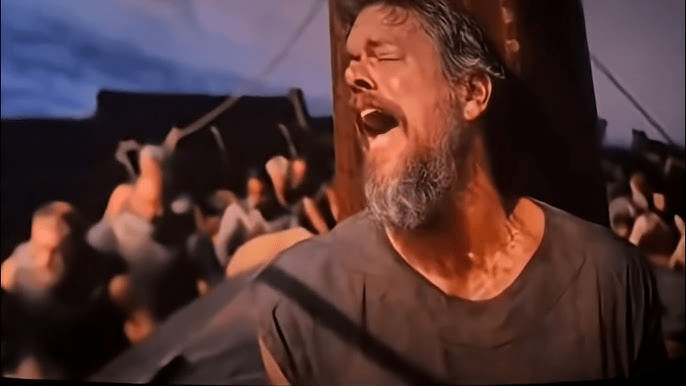
I am particularly interested in Siren’s call. But we can explore that another time. But I think there is much to explore in Chris Hayes use of this to describe our current challenges of living in an attention economy. In his book Siren’s Call: How Attention Became the World’s Most Endangered Resource, he argues that the American Dream has been undermined by a set of powerful and seductive “siren songs” that have lured the nation towards inequality and instability. Hayes argues that these “siren songs” have masked the reality of increasing inequality, declining social mobility, and a fraying social fabric. Odysseus being tied to the mast is a wonderful image of how Tisha B’Av makes us pay attention to collective pain and keep Jerusalem at the center of our national imagination.
And finally, as quoted above in Eicha, Judah is in exile and all he wants to do is come home. In all of his trials and tribulation he has found no rest amongst the nations. Like Odysseus journey of a decade , the Jewish people has spent thousands of years to return to our ancestral home in Israel. As we say in Hatikva:
As long as the Jewish spirit is yearning deep in the heart,
With eyes turned toward the East, looking toward Zion,
Then our hope ‐ the two-‐thousand-‐year-‐old hope-‐ will not be lost
I pause on this Tisha B’Av to realize that Jewish history has been quite an odyssey.
- See related post at The Sirens’ Call: Yom HaZikaron and the War on Attention


Leave a Reply